

What Makes TF1100-EP Portable Transit-Time Ultrasonic Flow Meter a Practical Solution for On-Site Flow Verification?
No flume to build. No pipe to cut. One submerged sensor at the flow itself.
As on-site flow spot-checking, meter verification and temporary monitoring grow, fixed-installed meters can't fully cover mobile multi-point measurement needs. The TF1100-EP portable transit-time ultrasonic flow meter is the preferred field-testing tool thanks to clamp-on non-intrusive installation, built-in rechargeable battery and flexible cross-site deployment. This guide covers its principle, core features, installation, maintenance, how it compares with fixed-mount meters, applications and FAQs.
1. How Does TF1100-EP Portable Ultrasonic Flow Meter Work?
The TF1100-EP works on the transit-time ultrasonic measurement principle, composed of a portable host unit, external clamp-on ultrasonic transducers and optional Pt1000 temperature sensors for heat-energy measurement.
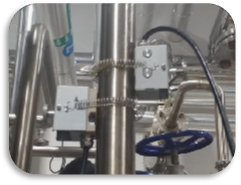
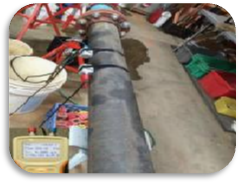
A pair of clamp-on transducers are externally attached to the outer pipe wall, alternately transmitting and receiving ultrasonic pulses. Sound waves travel faster downstream along fluid flow and slower against the flow direction. The host calculates fluid velocity and cumulative flow value by capturing precise propagation time difference. Since sensors are mounted outside pipelines, there is no need for pipe cutting, process shutdown or fluid contact. When paired with matched Pt1000 temperature probes, the unit can also compute thermal energy consumption for heating or cooling systems.

V method
2. What Core Characteristics Does TF1100-EP Portable Ultrasonic Flow Meter Possess?
3. What Are Standard Field Installation and Environmental Requirements?
• Choose V, Z or W mounting method according to actual pipe diameter.
• Do not mount transducers at welding seams or deformed pipe segments.
4. Where Is TF1100-EP Portable Ultrasonic Flow Meter Widely Applied?
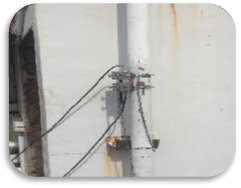
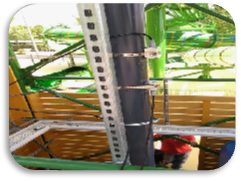
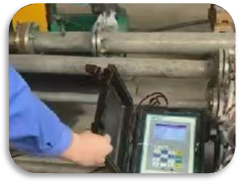
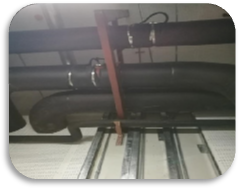
Benefiting from portability and non-cut installation, TF1100-EP portable ultrasonic flow meter is widely deployed across industrial and utility field-testing activities.
It is heavily used for water-balance testing in water plants, pipe network flow spot-check and verification against existing fixed meters. In district heating systems, it supports thermal-network balance commissioning, on-site heat-meter cross-check and temporary heat-consumption testing. It serves energy-saving audits for factories, commercial buildings, cooling-water and central air-conditioning circulating-water systems.
Besides, it fits temporary flow monitoring during equipment commissioning, pipeline troubleshooting and leakage-suspect investigation. It can also be applied in petrochemical, power plant, food-beverage industries for periodic spot measurement of various full-pipe liquid media.
5. How Does TF1100-EP Compare with Fixed-Mount Clamp-On Ultrasonic Flow Meters?
Both adopt the transit-time clamp-on measuring principle and neither intrudes into process pipelines, yet they differ greatly in application positioning.
FAQ
Does TF1100-EP need pipe cutting or process shutdown for installation?
No. It uses external clamp on transducers. No pipe cutting and no production interruption are required.
How long can TF1100-EP run on full battery charge?
The built-in rechargeable lithium battery supports continuous working for more than 50 hours.
What pipe diameters can TF1100-EP cover?
It supports a wide range from DN20 up to DN6000 mm, compatible with most metal and plastic pipeline materials.
Can TF1100-EP measure bi-directional flow?
Yes, bi-directional flow measurement is supported, both forward and reverse fluid flow can be captured.
What kind of liquid media is TF1100-EP suitable for?
It applies to clean liquids and slightly turbid liquids with turbidity less than 10000 ppm, such as water, cooling water, hot water, oil and some chemical fluids.
Can TF1100-EP perform heat-energy measurement?
Yes. When equipped with matched Pt1000 temperature sensors, it can calculate thermal energy for heating or cooling systems.
Will TF1100-EP cause pressure loss to process pipelines?
Zero pressure loss. Sensors stay outside pipe walls without inserting any parts into fluid flow path.
What maintenance should be done after each field measurement?
Clean transducer surfaces and cables, store accessories in protective case, and recharge the battery in time. Replenish acoustic couplant for next measurement.
Tell us your pipe — we'll size the meter
Share your pipe material, diameter, flow range and measurement needs. The Lanry team will recommend the right portable configuration for your field testing.
Hello, I am Arina Hu, Sales Engineer of Lanry Instruments. Graduating with a Bachelor's in Business English, I bring over five years of sales experience within the instrumentation sector. Having participated in multiple overseas exhibitions, I possess in-depth product knowledge of our complete instrument lineup and strong capabilities for international client engagement. Should you have any project demands for instruments, feel free to contact me. Feel free to contact my WhatsApp.
Post time: Sep-28-2026